
Several years ago, I wrote a blog titled “I Know What I Should Be Doing…But?”
And then, right at the beginning, I filled in the rest with whatever excuse applied.
“I know what I should be doing…but I just haven’t been doing it.”
People say that phrase so casually. Almost flippantly. As if change were as simple as flipping a light switch.
“I know what I should be doing to lose the 25 pounds I’ve wanted to lose for years, but I’m just not doing it.”
As if the gap between where they are and where they want to be is small.
As if they could just snap their fingers and arrive there.
But the truth is, for most people, that gap isn’t a gap at all—it’s a chasm.
And chasms don’t get crossed by good intentions.
They get crossed with help.
Most people aren’t failing because they don’t care.
They’re failing because they’re missing skills.
They’re missing perspective.
They’re missing structure.
They’re missing the mindset required to bridge that distance.
And in many cases, what they’re missing is a coach.
What “Skin in the Game” Really Means
When I talk about skin in the game, I’m talking about commitment—often financial commitment.

I can’t tell you how many times clients have said to me at the gym:
“If I didn’t have this session booked with you today, I wouldn’t be here.”
They had a bad night’s sleep.
A rough day at work.
A sick dog.
A stressful morning.
Insert excuse here.
Left to their own devices, those emotions would have won. But because they had skin in the game—because they had made a commitment—they showed up anyway.
That alone is enormous value.
Information Isn’t the Problem
Part of the value of a coach is knowledge and wisdom—especially in nutrition. But let’s be honest: we don’t suffer from a lack of information.
We suffer from too much of it.
We carry the world’s information in our pockets. It’s free. It’s endless. And much of it directly contradicts itself.

The real skill isn’t finding information.
The skill is distilling it.
Knowing what matters.
Knowing what applies to your life.
And then applying it long enough to see results.
Even then, information alone still isn’t enough.
I can hand someone a perfectly structured meal plan. On paper, it’s flawless. But if I leave them to execute it on their own—without coaching—the odds of success drop dramatically.
Which brings us right back to the same conclusion:
You still need a coach.
The Coach as a Catalyst
There’s a quote often attributed to Tom Landry, and I’ll paraphrase it here:
A coach is someone who gets you to accomplish far more than you ever would on your own.

Left to ourselves, we let ourselves down all day long.
But for a coach?
For the right relationship?
People will run through brick walls.
When you look at the greatest coaches in history, what stands out isn’t just the number of wins—it’s how those wins were sustained over time.
Take Nick Saban.
Year after year at Alabama, players come and go. Seniors graduate. Underclassmen leave early for the NFL. Recruits arrive with wildly different backgrounds, skill levels, and levels of maturity. Injuries happen. Depth charts change. Nothing about the roster is static.
And yet, the results remain remarkably consistent.
The same can be said—perhaps even more powerfully—of John Wooden at UCLA.
Wooden’s teams won ten national championships in twelve years. That kind of dominance is almost impossible to comprehend, especially at the college level. Every four years, the roster turned over. Players graduated. New players came in. Some stayed. Some struggled. Some flourished.
And still—the standard never dropped.
That’s the key point.
The common denominator in both programs wasn’t the players.
It was the system.
It was the standards.
The expectations.
The culture.
The daily process.
Nick Saban didn’t build Alabama around individual stars. He built it around a process of excellence. John Wooden famously focused so little on winning that many players said they barely heard the word mentioned. Instead, he obsessed over preparation, fundamentals, character, and doing things the right way—every single day.
The magic wasn’t talent alone.
It was leadership.
It was structure.
It was coaching.
And this is where the parallel to fitness and nutrition becomes obvious.
People don’t struggle because they lack desire or intelligence. They struggle because, left on their own, there is no system—no standard, no process, no outside voice to help them stay consistent when motivation fades or life gets messy.
A good coach doesn’t just provide information. A good coach builds a framework—one that makes success more likely even on the days when discipline is low, and excuses are loud.
That’s exactly how great coaching works in real life.
Left to themselves, people drift. They default to comfort. They rationalize inconsistency. But under the guidance of a strong coach—someone who establishes clear standards, simplifies the process, and holds people accountable—ordinary individuals consistently do extraordinary things.
Not because they suddenly became different people.
But because they were placed inside a system that demanded more of them than they would ever demand of themselves.
And that’s where skin in the game matters.
When someone commits—financially, emotionally, or relationally—they step into the system. They show up differently. They listen differently. They act differently. Not because the coach is magical, but because the commitment itself changes the dynamic.
That commitment is what transforms potential into progress.
Effort into results.
And intention into lasting change.
That’s what great coaching does.
It acts as a catalyst.
Distilling the Noise
John Maxwell once said the difference between a speaker and a communicator is that a communicator can take complex, high-level information and put the cookies on the bottom shelf—so everyone can reach them.

That’s coaching.
In nutrition, that might sound like this:
“Four meals a day.
Protein at every meal.
That’s your focus right now.
Stop reading every blog post. Stop watching every YouTube video. You’re tying yourself in knots.”
That level of clarity—for that individual—is invaluable.
Accountability Multiplies Results
Jack Canfield, co-author of the Chicken Soup for the Soul series, shared something that has always stuck with me.
Simply writing a goal down increases your chances of success to around 42%.
Add an accountability partner, and that number jumps to roughly 76%.
Not because they’re experts.
Not because they’re doing the work for you.
But because you know you’ll have to report back.
That’s accountability. And it’s powerful.
The Best in the World All Have Coaches
The most successful people in the world—athletes, executives, actors, business leaders—all have coaches.
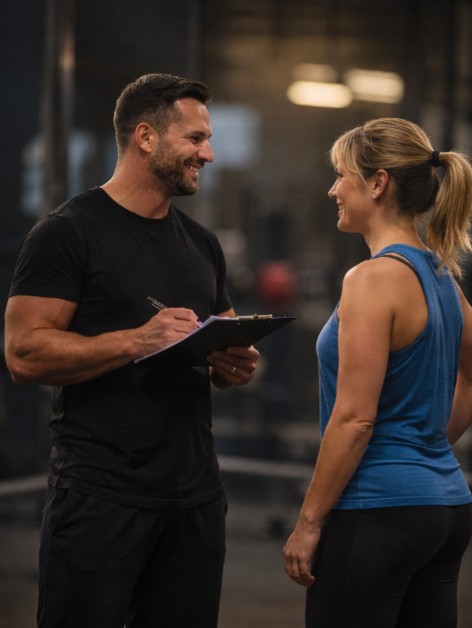
Professional golfers are a perfect example. Swing coach. Short-game coach. Mental coach. Fitness coach. Nutrition coach.
From the business world, Harvey Mackay is another. How to Swim with the Sharks Without Being Eaten Alive was the first personal development book I ever received. Harvey is now in his 90s and still actively working—with multiple coaches at any given time.
Why?
Because growth never stops. And neither does coaching.
Change Requires Change
I learned this lesson the hard way.
In the early 1990s, I had a mentor named Walter Pate. He was my sponsor and, in many ways, my coach in a sales and marketing business. We had a weekly accountability call—structured, consistent, and intentional.
In other words, I did exactly what so many people say they want to do.
I reached out for help.
Walter and his wife, Marie, were incredibly patient with me. I was young, inexperienced, and short on confidence. Emotionally, I was all over the place—up one week, discouraged the next. Prospecting adults who were ten, twenty, or thirty years older than me felt intimidating, and I struggled to do the work consistently.
But here’s the part that matters.
Walter did his job.
He showed up.
He listened.
He guided.
He held me accountable.
I didn’t always do mine.
One day, very calmly and without criticism, he said something that stopped me in my tracks. He wasn’t being harsh or scolding. He was simply being honest.
“I know you’re not happy with where you are in life,” he said. “I know you want more—we’ve talked about it. But if you’re not willing to do anything different, you’ll look back five or ten years from now with the same frustrations you have today.”
Then he said something I’ve never forgotten:
Change requires change.
He was right.
The system was there.
The coaching was there.
The accountability was there.
What was missing was my willingness to consistently listen and act.
I didn’t fail because I lacked support. I failed because I wasn’t willing to do the work long enough to earn the result.
And that distinction matters.
Because a coach isn’t a magic wand. Coaching doesn’t override personal responsibility. It amplifies it.
When you choose to work with a coach, you’re not outsourcing the work—you’re committing to it.
That lesson has stayed with me for life.
The Bottom Line
From 2000 to today, obesity rates have climbed steadily—despite unlimited access to information.
The problem isn’t knowledge.
The problem is the application.
And persistence.
We live in a microwave, instant-gratification society. People want quick fixes. Can you say GLP-1 agonists? Or whatever the latest gimmick happens to be.
But success doesn’t work that way.
Success takes hard work, and the rent is due every day.
And left to their own devices, most people will struggle.
That’s why coaching matters.
A coach guides.
Encourages.
Simplifies.
Holds accountable.
Picks you up when you fall.
And yes—occasionally delivers a well-timed, strategic kick in the pants.
That’s skin in the game.
And that’s why it works.
Call to Action:
If this resonated with you, here’s a simple question worth sitting with:
If you truly want a different result, what are you willing to do differently?

For some people, that means continuing to go it alone. For others, it means finally putting skin in the game—seeking guidance, accountability, and support instead of relying on willpower and good intentions.
If you’re tired of knowing what you should be doing and want help actually doing it, I’d be honored to come alongside you.
You can start by subscribing to the blog, where I share practical insights on training, nutrition, recovery, and long-term health. And if you’re interested in personalized coaching—whether that’s fitness, nutrition, or lifestyle support—you’re welcome to reach out and start a conversation. Please click on Work With Kelly.
No pressure. No gimmicks. Just an honest discussion about where you are, where you want to go, and whether working together makes sense.
Because real change starts when you decide to stop going it alone.
 kellyamidonblog.com
Leave a comment