
Several years ago, I completed Precision Nutrition’s Sleep, Stress Management, and Recovery course. I was actually in their inaugural cohort, and while I was interested in stress and recovery, I was far more interested in sleep. My sleep had become a struggle for several years, so I enrolled in that course selfishly, hoping to find some answers for myself — and, professionally, to better serve my clients.
Little did I know that a simple, and yet straightforward statement from the course would end up burning itself into my brain:
“A training program is only as good as your body’s ability to recover and grow from it.”
At the time, I remember thinking how that single sentence could be zoomed out far beyond training. Because it’s true in every area of life. Work. Play. Family. Stress. Everything.
Anything you do is only as beneficial as your body’s ability to tolerate it, adapt to it, and recover from it.
Think about exercise as an example. Let’s say you start your day at 100% recovery. You train hard and drop to 80%. If all you do is climb back to 100% and then repeat the same exact session, you’re spinning your wheels. There’s no margin left for growth. No supercompensation. No progress.
All fine and good in theory…But how do you measure that?
I didn’t have an answer.
I had the concept — but not the tool.
And that’s where this entire story begins.
My Five-Legged Stool (and the Missing Piece)
For years, I taught my clients a simple framework:
Your health is a five-legged stool.
- Exercise (strength + cardio)
- Nutrition (food + supplements)
- Medical (doctor visits, labs, assessments)
- Sleep, stress management, and overall recovery
- Emotional health
If any leg is weak, the stool wobbles. If you neglect any one leg enough, the stool will crash. The connection is easy, and if you neglect any area of your health enough, you’re headed for trouble.
Back then, I had systems for all of these — except one.
The recovery piece.
You can track sleep. You can track steps. You can track macros.
But how do you track your body’s ability to handle life?
I didn’t have an answer.
Not yet.
I had heard about heart rate variability (HRV). I even wore an Oura Ring. But no one had ever impressed on me how important HRV actually was — so it just felt like another number on a dashboard.
It wasn’t until the last few months that everything clicked.
The Sequence of Events That Changed Everything
About a year ago, one of my closest clients gave me Peter Attia’s book Outlive.
That book rocked my world.
It sent me deep into the rabbit hole of:
- VO₂ max
- Longevity
- Metabolic health
- Cardiovascular training
- The integration of strength, zone 2, and intensity
And when you follow Peter long enough, you learn quickly: the man measures everything.
He even pricks his finger to measure lactate mid-workout.
(That’s insane — Peter makes me look sane.)

I heard him mention that he used a heart rate monitor called Morpheus. At the time, I shrugged it off. Just another tool. I was using a Scosche arm strap-based heart rate monitor and had graduated from using a Fitbit Charge 4. I did the research and knew the Scosche offered a significant jump in accuracy over a fitness watch or ring, so I wasn’t hunting for something new.
In complete transparency, I had a bit of a block with chest strap-based heart rate monitors due to two previous negative experiences with Polar. I found their devices inconsistent at best, and unfortunately, this may have influenced me to avoid considering Morpheus.
But then my Scosche strap literally exploded. And then the same client who gave me Peter’s book — Phil — had been following Peter, too. He saw that Peter used Morpheus, bought one… and bought me one as well.
I had no idea how much that gift was about to change my life.
What Makes Morpheus Different
Morpheus was created by Joel Jamieson, one of the world’s leading experts in HRV.
Twenty years of HRV work.
MMA fighters.
NFL athletes.
Seattle Seahawks.
High-level performance across the board.
Joel’s original system was called BioForce.
Morpheus is the evolved, massively improved version.
Here’s what makes it stand out:
Chest strap accuracy
Chest straps measure the electrical impulse of the heart.
Watches and rings use optical technology — far less accurate.
Daily recovery test
Each morning:
- Put on the chest strap
- Sit still
- Enter sleep hours
- Rate soreness
- Rate how you feel
- Let Morpheus run a 2.5-minute HRV test
This generates your recovery score, based on the last 24 hours of data.
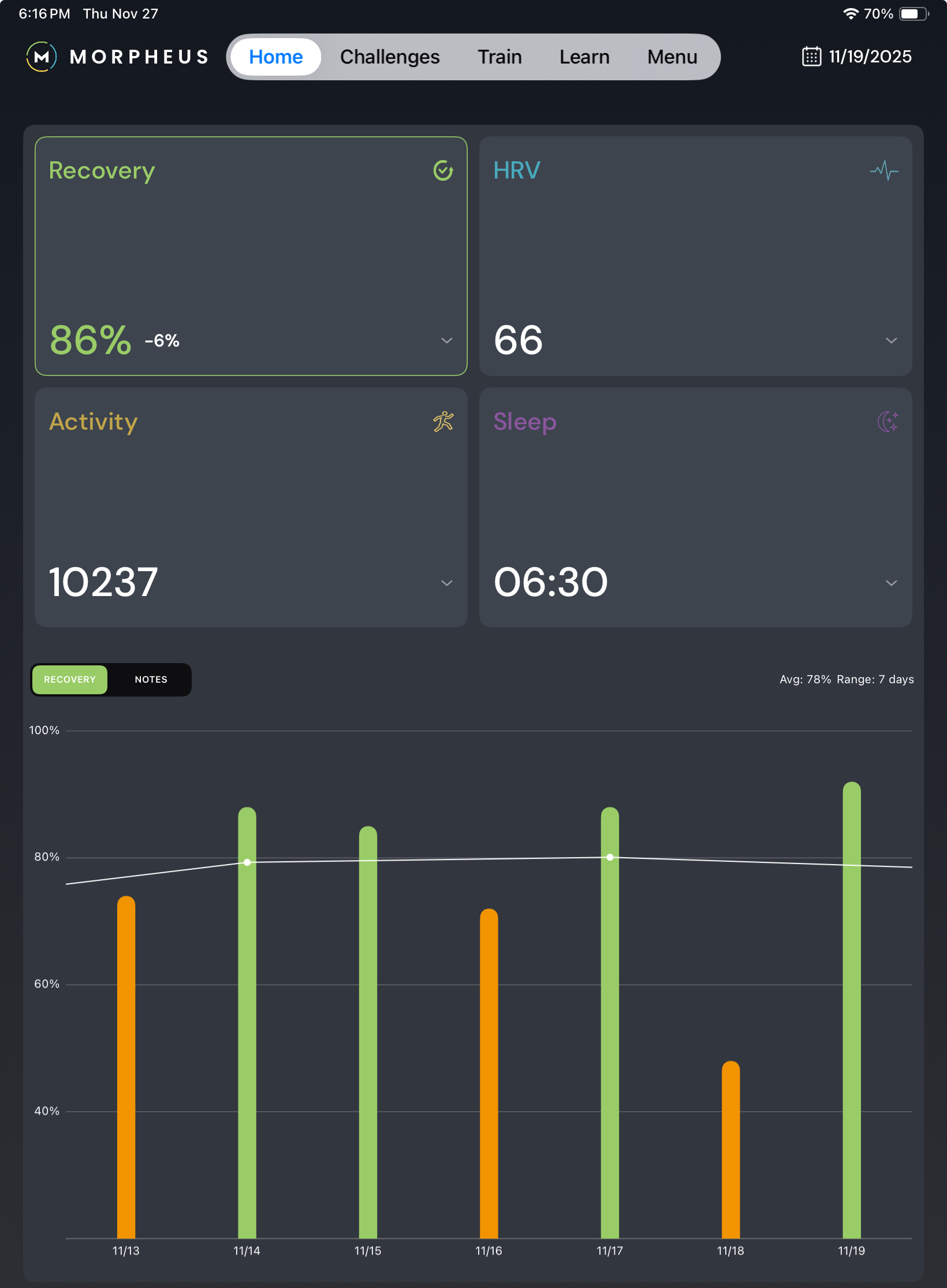
Three individualized training zones
Based on over one million data points — the equivalent of training 1,000 people a day for 1,000 days — Morpheus assigns:
- Blue = Recovery
- Green = Conditioning
- Red = Overload
You are then given a weekly cardio target personalized to your age, fitness level, and goals.
It measures load — not just activity.
Morpheus doesn’t tell you how to lift. But it tells you exactly what that lifting costs your body.
And that’s where the magic happens.

My Wake-Up Call (the Moment Everything Changed)
Here’s where I have to confess something:
For the first several weeks, I wasn’t even doing the morning recovery test.
I was only using Morpheus to track:
- Calories burned
- Workout intensity
- Cardio zones
I wasn’t using it for the actual point: RECOVERY.
Then Phil showed me his app. “Why do you have all this extra data?” I asked. He said, “Because you have to take the recovery test each morning.” Oh.
So I started. And the timing could not have been more perfect… or more disastrous.
Enter: Time Change Weekend
I knew exactly what would happen:
- My body cannot sleep in. It is physiologically impossible.
- The time change meant waking at 3:00 a.m.
- Sunday began an hour early.
- Monday: still 3:00 a.m.
- Tuesday: still 3:00 a.m.
Add:
- A hard upper-body session on Sunday
- A brutal leg day on Monday
- Two hours of lost sleep
- Caffeine
- Life stress
- Work stress
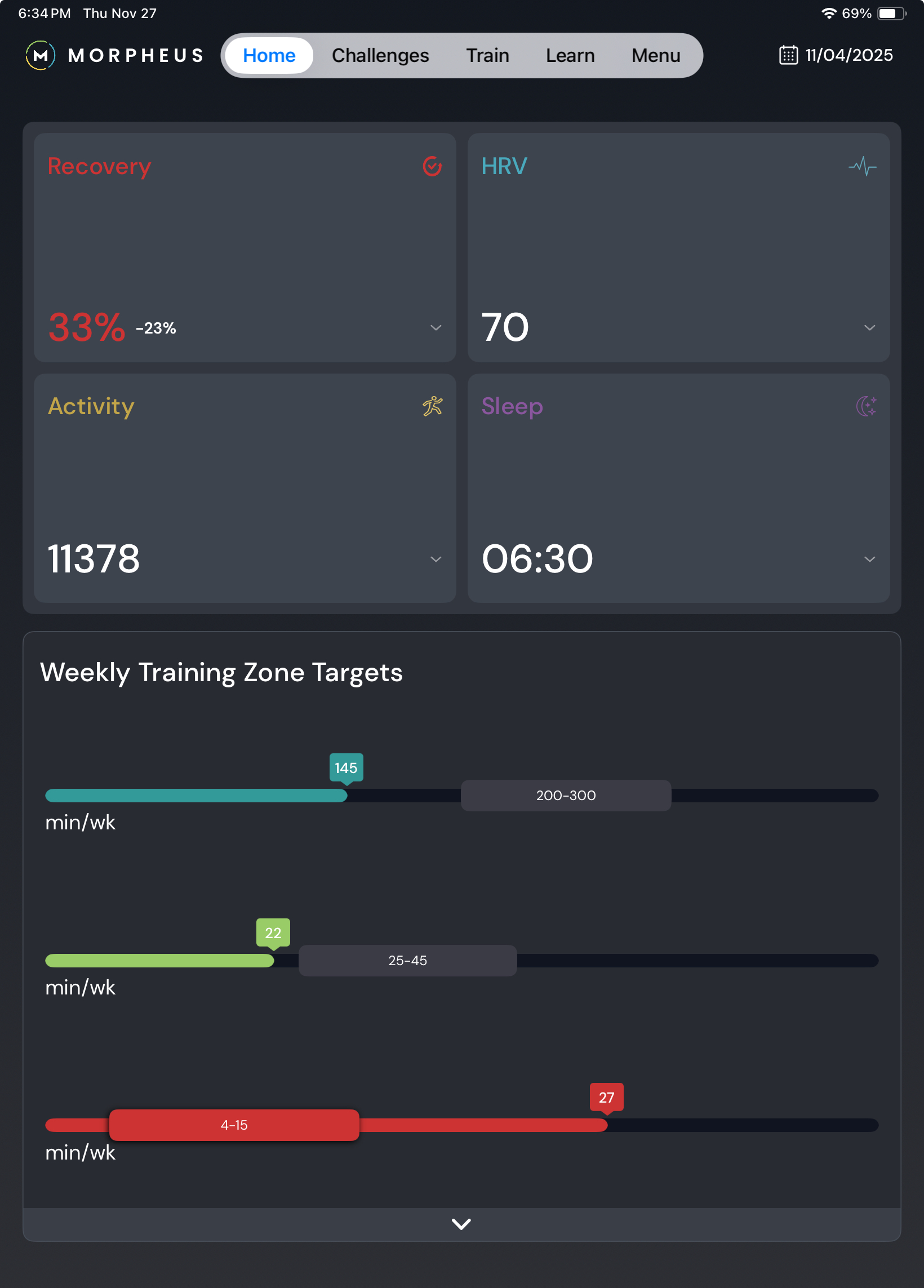
Tuesday morning, I finally checked my recovery.
56%. Bronze.
And I still didn’t fully understand what that meant.
So I trained hard again. Crushed myself on cardio.
My recovery dropped 23 more points.
I ended at 33%. Red
That’s when the alarm bells went off.
That was my moment.
My wake-up call.
My turning point.
The Pivot That Saved Me
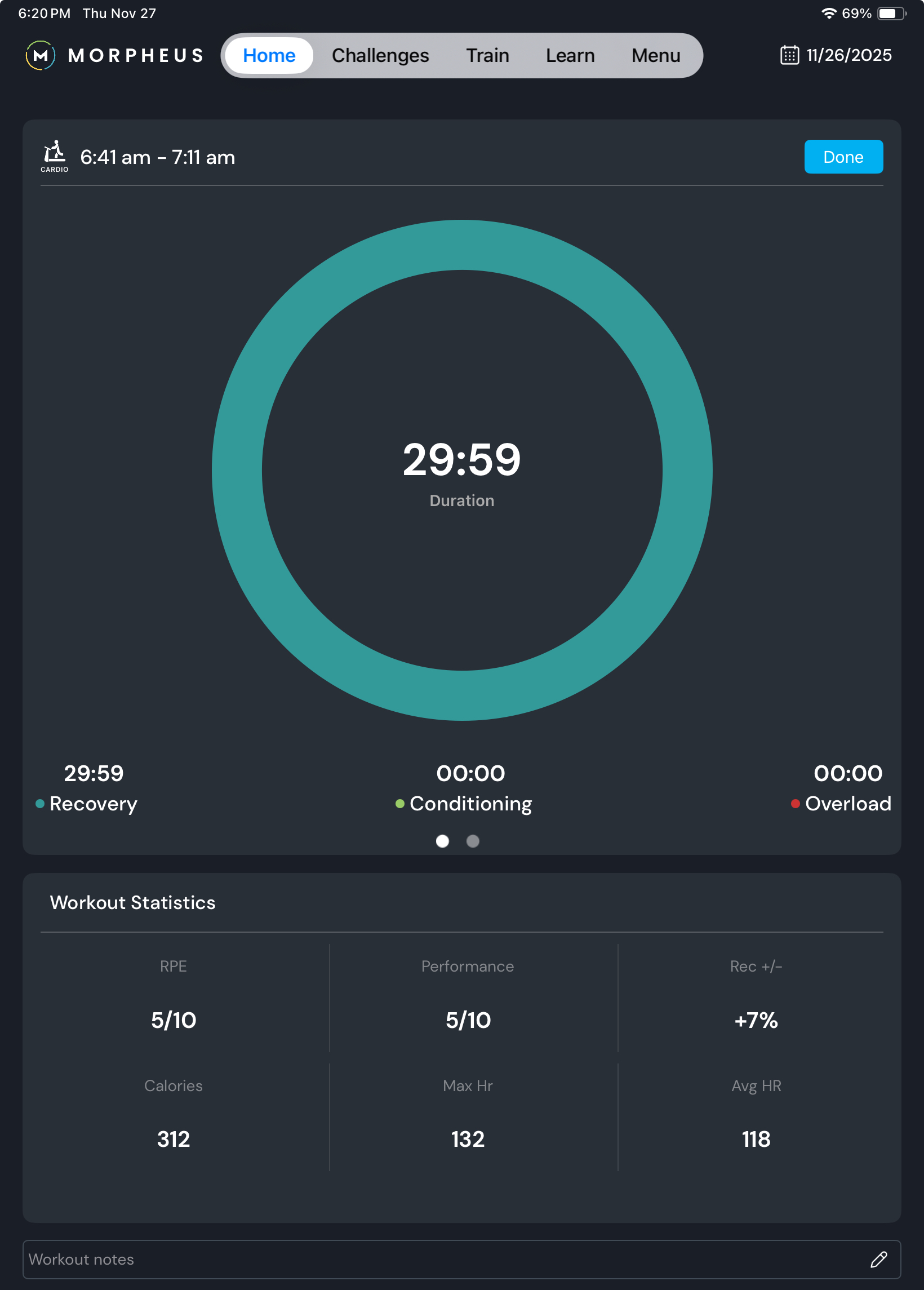
Two days later, on Thursday, I was scheduled for cardio again.
This time, I spent the entire hour only in the blue “recovery” zone.
Not easy — the upper limits of the recovery zone can still be challenging — but controlled.
And guess what?
My recovery improved after that session rather than going further in the hole.
And since that first week in November, despite a crazy month that included sleep issues and even an emergency room visit due to vertigo, I’ve watched my recovery trend upward — slowly, steadily, consistently.
Because I stopped training blind.
Why “Feeling Off” Is Not Enough
As a fitness professional, I hear this daily:
- “I just don’t have it today.”
- “Something feels off.”
- “I didn’t sleep great.”
- “I’m dragging.”
People feel under-recovered. But they don’t know.
If they had Morpheus, they’d see exactly why.
They’d see the recovery score.
They’d know how hard to train — or whether they should pull back.
This is training with intelligence rather than ego.
This is how you prevent burnout, plateaus, injuries, and chronic fatigue.
What About Oura? Whoop? Apple Watch?
They all offer a version of a “readiness score.”
And I’m not here to bash any of them.
In fact, I think:
- Oura is a phenomenal sleep tracker
- Whoop provides useful trends
- Apple Watch is solid for general activity
But when it comes to heart rate accuracy and HRV, optical technology simply cannot match a chest strap.
- Rings = optical
- Watches = optical
- Morpheus = electrical impulse → chest strap → far more accurate
So while Oura’s readiness score is helpful, a large portion of its score is tied to heart-rate-related metrics, which makes it less precise.
If you want to train based on how your body is actually responding, Morpheus is in a different league.
Your Body Is a Battery
Now we arrive at the real point of this entire blog:
Your body is a battery.
When you’re fully charged, you can train hard.
You can push.
You can grow.
But when you’re drained:
- Your workouts suffer.
- Your sleep suffers.
- Your immune system suffers.
- Your stress tolerance drops.
- And your performance tanks.
Most people wake up every day without knowing their battery level.
They train blind.
They eat blind.
They push blind.
They guess.
Morpheus gives you the battery meter.
The dashboard.
The truth.
And once you know the truth, you can finally train with intelligence instead of emotion.
Final Thoughts
I can’t recommend Morpheus highly enough. It has changed how I train, coach, plan my weeks, and understand my own physiology.
And I plan to systematically introduce it to every client I work with — because it’s that powerful.
You can’t manage what you don’t measure. And you can’t train wisely if you don’t know your recovery.
Your body is a battery.
The question is simple:
Do you know your charge level today?
Resources:
To get your own Morpheus, go to Morpheus Training System
To learn more from Joel Jamieson, go to 8 Weeks Out
While I’ve had the privilege of connecting with Joel Jamieson and he’s been incredibly generous in helping me integrate Morpheus into my own life and my clients’ programs, I want to be clear that I have no financial affiliation with Morpheus or with Joel’s 8WeeksOut platform. I recommend these tools for one reason only: they’re powerful resources that can help you understand your recovery, manage your stress, and take better care of your health. What you choose to invest in is completely up to you — my only goal is to point you toward things that genuinely make a difference.
 kellyamidonblog.com
Leave a comment