
“Calories in, calories out” is often described as a fundamental principle for weight loss. On the surface, it sounds logical. Eat fewer calories than you burn, and the weight should come off. Simple math.
But if it were truly that simple, long-term weight loss wouldn’t be the struggle that it is for so many intelligent, disciplined people.
The problem isn’t that calories don’t matter.
The problem is that calories alone don’t explain how the human body actually works.
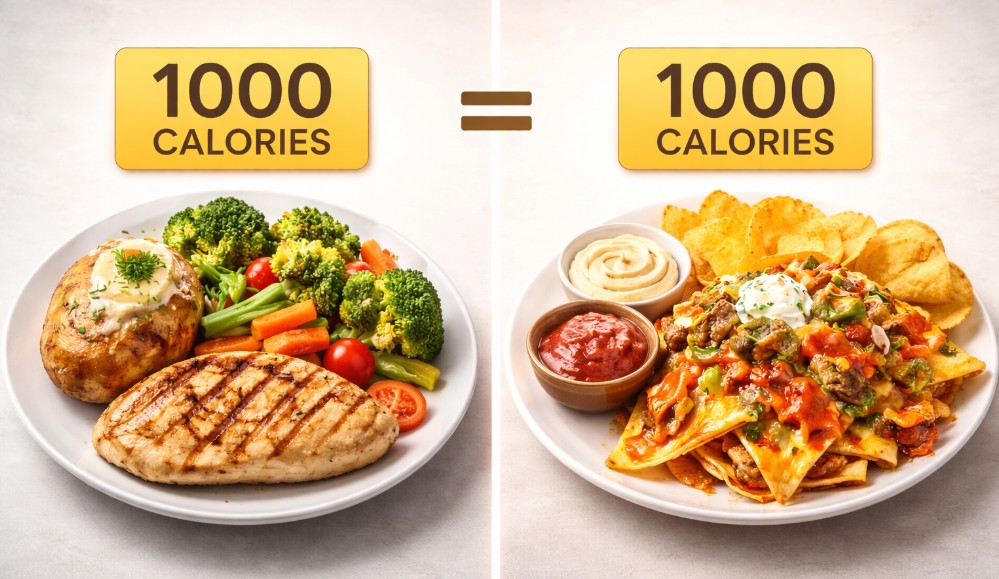
Calories Are a Measurement, Not a Mechanism
Energy balance exists. No one disputes that.
However, the calories-in versus calories-out equation is a descriptive equation, not a biological control system. It tells us what happened, not why it happened.
Two people can eat the same number of calories and experience entirely different outcomes:
- One loses weight
- One maintains
- One gains
That alone should tell us the model is incomplete.
Real-World Metabolism Is Not One-Size-Fits-All
I see this with clients every week.
I currently maintain my body weight by eating roughly 2,800–3,100 calories per day. Meanwhile, I work with clients who are significantly heavier than I am, eat well under my average daily intake, and lose weight steadily while feeling great.
Same planet. Same laws of physics.
Very different metabolic engines.
Why?
Because metabolism is influenced by:
- Lean body mass
- Daily activity (including unconscious movement)
- Training load
- Sleep quality
- Stress
- Hormones
- Genetics
Calories don’t exist in a vacuum. They exist inside a living, adaptive system.
Food Is More Than Energy — It’s Information
One of the most helpful ways to think about food is this:
Food is to the body what software is to a computer.
Different inputs create different outputs.
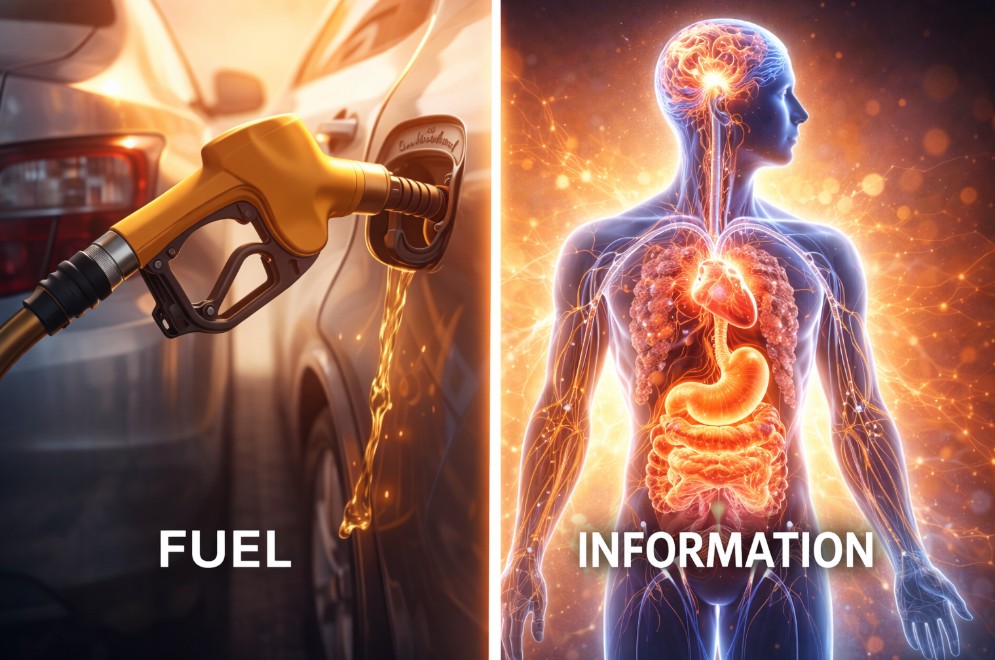
A meal of grilled chicken, vegetables, and potatoes sends very different signals than a meal of chips, nachos, or sugary snacks—even if the calorie totals are identical.
Why? Because food influences hormones that control:
- Hunger
- Satiety
- Fat storage
- Fat burning
- Metabolic rate
Calories may be equal on paper, but their physiological impact is not equal.
Why Protein Behaves Differently Than Carbs and Fat
This is a critical distinction that often gets overlooked.
Excess Protein Is Hard to Store as Body Fat
Protein is metabolically “expensive”:
- Roughly 20–30% of its calories are burned during digestion and processing
- It strongly increases satiety
- It preserves lean muscle mass
For protein to be stored as body fat, the body must go through a long, inefficient conversion process. It can happen—but it’s biologically unfavorable.
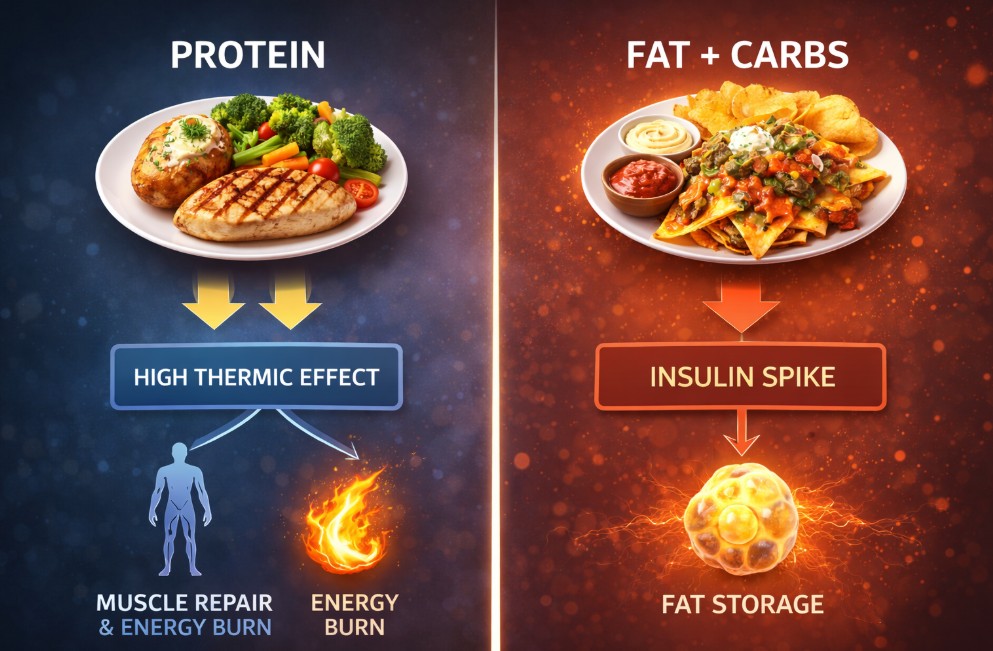
In practical terms:
It is very difficult for the body to turn excess protein into fat.
Fat + Carbohydrates Together Are a Different Story
When carbohydrates raise insulin, and dietary fat is present at the same time:
- Fat burning is suppressed
- Dietary fat is more likely to be stored
This is why highly processed foods that combine fat and carbohydrates are uniquely effective at promoting fat gain, especially in a calorie surplus.
Protein changes that entire hormonal response.
The 3,500-Calorie Rule Falls Apart in Real Life
You’ve probably heard this before:
Cut 500 calories per day and you’ll lose one pound per week.
That rule assumes:
- Metabolism stays constant
- Activity stays constant
- Hormones stay constant
None of those assumptions is true.
The human body adapts. When calories drop, energy expenditure often follows—sometimes subtly, sometimes dramatically. This is why plateaus occur and why chronic dieting frequently backfires.
Even Calorie Tracking Isn’t as Precise as We Think
There’s another practical problem with relying heavily on calorie math:
Food labels and calorie counts are not exact.
In fact, nutrition labels are legally allowed to be off by up to 20%.
That means someone aiming for 2,000 calories could unknowingly be eating:
- 1,600
- or 2,400
And still believe they’re being “precise.”

Even more confusing, if you calculate calories manually using macros:
- Protein (4 calories per gram)
- Carbohydrates (4 calories per gram)
- Fat (9 calories per gram)
You’ll often find the total does not match the stated calorie count on the label.
So which number is wrong?
The honest answer is: we don’t know.
This doesn’t mean tracking is useless. Tracking can be extremely valuable for:
- Awareness
- Learning portion sizes
- Identifying patterns
- Improving protein intake
But it is not a precision instrument, and treating it as one often creates unnecessary stress and frustration.
A Better Way to Think About Weight Loss
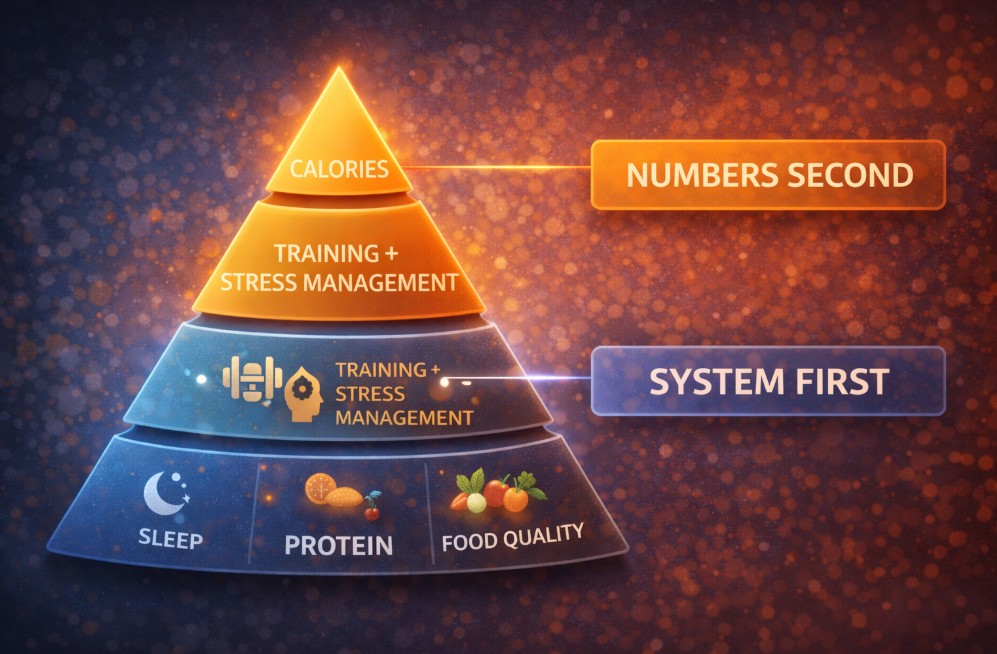
Calories matter—but they are not the primary lever.
A more accurate framework looks like this:
- Prioritize protein
- Improve food quality
- Support recovery and sleep
- Manage stress
- Train intelligently
- Allow metabolism to function, not fight it
When the system improves, calorie balance often takes care of itself.
Final Thought
Most people don’t struggle with weight because they “don’t know what to do.”
They struggle because the human body is not a calculator.
Calories influence outcomes—but biology determines them.
And that’s why coaching, context, and individualized guidance matter far more than chasing numerical perfection.
Call to action:
If this article challenged how you’ve been thinking about calories and weight loss, that’s a good thing. The human body isn’t a calculator—and lasting results rarely come from chasing numbers alone.
If you’d like help simplifying your approach, improving food quality, or building a plan that actually works for your body, I’d be glad to help.
Reach out via “Work with Kelly“ or leave a comment below—this is a conversation worth having.
 kellyamidonblog.com
Leave a comment