
VO2 max is simply the maximum amount of oxygen your body can use during intense exercise. It’s measured in milliliters of oxygen per kilogram of body weight per minute (ml/kg/min). Higher numbers equal better cardiorespiratory fitness—and it’s one of the strongest predictors of longevity and maintaining independence in your later years.
The topic of VO2 max has been all the rage in fitness circles over the last several years. A big reason for that is the work of Peter Attia, M.D., and especially his outstanding book Outlive. I consider it the ultimate bible on fitness and longevity.
I’ve been a fitness professional for just over eight years at Lifetime Fitness, and we’ve always embraced cardiovascular fitness in a big way. We offer metabolic coaching that includes active metabolic assessments, which measure your VO2 max. Even though I’ve been lifting weights for over 40 years (I started at 15), I’ve always known cardio was important. But for most of my life, my training was heavily influenced by bodybuilding culture. In that world, cardio was mainly a contest-prep tool to strip body fat down to single digits. In the off-season? Not so much. For the vast majority of my lifting career, I averaged maybe 30–60 minutes of cardio a week—tops—except when I was competing myself.
That all changed a couple of years ago thanks to a thin thread of circumstance. One of my longtime clients, Phil Overton, handed me Outlive by Peter Attia. It was a total game-changer. I devoured the book, then started following Peter’s podcasts and interviews. Overnight, I completely changed my training. If this is 2026, the shift happened in mid-2024. I still remember taking my first active metabolic assessment on July 31, 2024. I scored surprisingly high, which I credit to decades of hard training, including competitive swimming, and my overall competitive background. That test lit a fire under me. I even became a certified metabolic specialist at Lifetime so I could share the importance of VO2 max with my members and clients.
We had a brief pause in our metabolic testing program during 2025 while corporate secured a new vendor, but it’s back in full swing now. And even though I’ve been preaching this stuff since 2024, I’m still learning and refining the message every day.
Strength Training and Cardio Are Not the Same Thing
One of the clearest insights I’ve gained recently came from Joel Jamison, a pioneer in heart rate variability (HRV) training who’s been using the technology with athletes for over 20 years. He made it crystal clear: the elevated heart rate you see from lifting weights is completely different from the elevated heart rate you get from cardio. They come from different energy systems and different physiological demands.
As Joel explains, the heart rate increase you see during strength training is driven primarily by pressure and stress, not by sustained oxygen demand. Heavy lifting creates high muscular tension, restricts blood flow, spikes adrenaline, and dramatically increases blood pressure. The heart responds by working harder against that pressure, which over time leads to thicker, stronger heart walls. This is a powerful adaptation—but it is pressure-based.
Cardiovascular training works through an entirely different mechanism. Instead of pressure spikes, cardio creates a sustained demand for oxygen delivery. The heart rate rises because the body needs to move large volumes of oxygenated blood to working muscles for extended periods. Over time, this trains the heart to pump more blood with each beat, improves stroke volume, and enhances the body’s ability to use oxygen efficiently. This is a volume-based adaptation.
You need both. If you have all the strength in the world but your cardiovascular system can’t handle a flight of stairs, you’re in trouble. Vice versa—if you’re aerobically fit but lack strength, you’re still limited. The magic is in the combination.
The Real Reason This Matters: Independence in Your Golden Years
What really inspired this post is something I learned from Peter Attia about maintaining independence as we age. The aging process starts the day we’re born, but around age 30, if you’re not strength training, you lose about five pounds of muscle every decade. By 80, that’s 25 pounds gone. Your muscles are the engines that move you, stabilize you, and protect you from falls—and falls in older adults carry a 25% mortality rate in the first year.
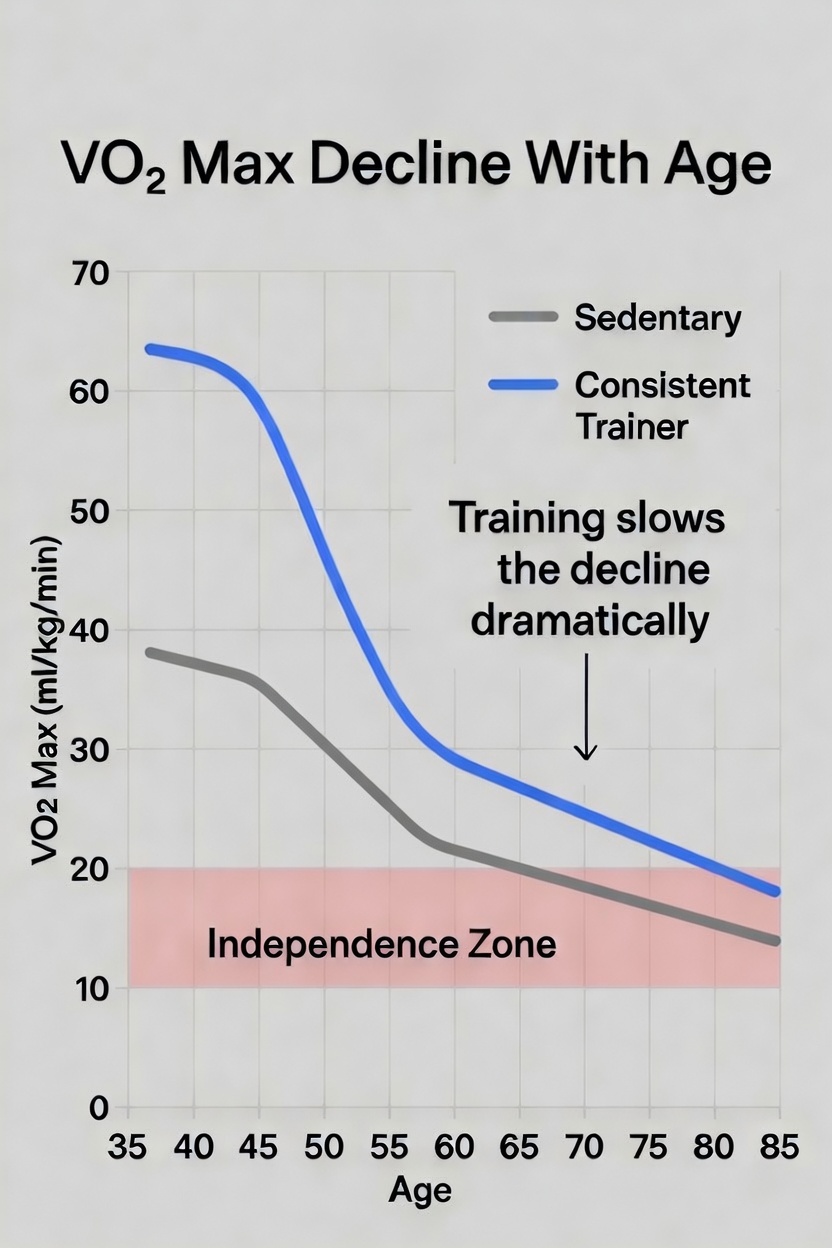
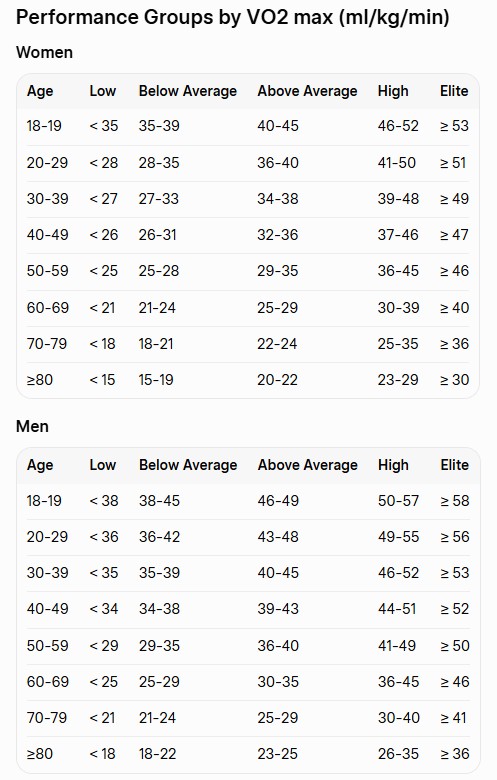
On the cardiovascular side, the picture is just as stark. Look up any VO2 max reference chart (they cover ages from late teens to 80+ and rate fitness from “very poor” to “elite”). There’s a critical number—roughly 18 ml/kg/min for men (a bit lower for women). Drop below that threshold, and you lose the ability to perform basic activities of daily living on your own: driving to the grocery store, carrying bags, cleaning your home, even getting up from the floor. You lose your independence. That’s not theory; it’s what the data shows.
I have this vivid analogy that plays in my head every day at the gym. We have a pool right next to the weight area, separated by glass. If I saw someone drowning, I’d call out a Code 100 or medical emergency, grab a lifebuoy, and jump in. That’s exactly how I feel about sharing this message. People are unknowingly heading toward a future in which simple daily tasks become impossible—not because of a sudden accident, but because they never built a fitness foundation.
Yet most people have no idea what VO2 max even is. If I polled members at the gym, the majority would look at me like, as my Granddad used to say, “A cow staring at a new gate.” And that’s just gym-goers—the vast majority of the population doesn’t even have a gym membership.
Backcasting and the Centenarian Decathlon
Peter Attia has a powerful tool he uses with every new patient: the Centenarian Decathlon. He asks them very specifically what physical activities they want to be able to do in the last ten years of their life. Play 9 holes of golf? Travel independently and walk through the airport without a scooter? Play on the floor with grandkids and stand up on their own? Be intimate with their spouse?
Once you define those goals, you backcast, and AI makes this easy. You assign each activity the required VO2 max, strength, mobility, and stability needed at age 85 or 90, for example, then figure out where you need to be today to get there, accounting for the natural decline that comes with aging.
I’m 58. My biological age is 58, but my training age is over 40 years. I still make progress in the gym, but I’m realistic about how much muscle I’ll add over the rest of my life. The good news? Your runway for improving cardiovascular fitness is much longer. Peter shares the story in Outlive of a Frenchman over 100 years old who was still competing in cycling races and improving his VO2 max into the low 30s. If a centenarian can do it, the rest of us have zero excuse.
It’s Never Too Late—and the Stakes Are Real
I train dozens of clients in their 60s, 70s, and 80s. The difference between those who exercised consistently for decades and those who are now making up for lost time is night and day. But here’s the hopeful part: even if you’re “upside down” right now, you can still improve dramatically. Older adults respond beautifully to training.
Just this week, I had a conversation that hit me hard. I was waiting for a client when a concierge team member pointed out an older gentleman coming in with his wife. He was using a three-wheeled walker and moving very slowly. I held the door, introduced myself, and asked what he was working on for the day. He told me he’s in physical therapy because he’s “losing the ability to walk.” When I asked what happened, he said, “I didn’t exercise when I was younger.” He’s 86. Nothing dramatic—just the slow, quiet cost of decades without proactive training.
That story is why I’m writing this. You can either pay the price of discipline now or pay a much steeper price later.
As the late, great Jim Rohn said: “We must all suffer from one of two pains: the pain of discipline or the pain of regret. The difference is discipline weighs ounces while regret weighs tons.”
How to Get Started
The gold-standard way to measure VO2 max is an active metabolic assessment (exactly what we offer at Lifetime). You wear a mask, do a progressive test until you reach your limit, and the system gives you your exact VO2 max, heart-rate training zones, and more.
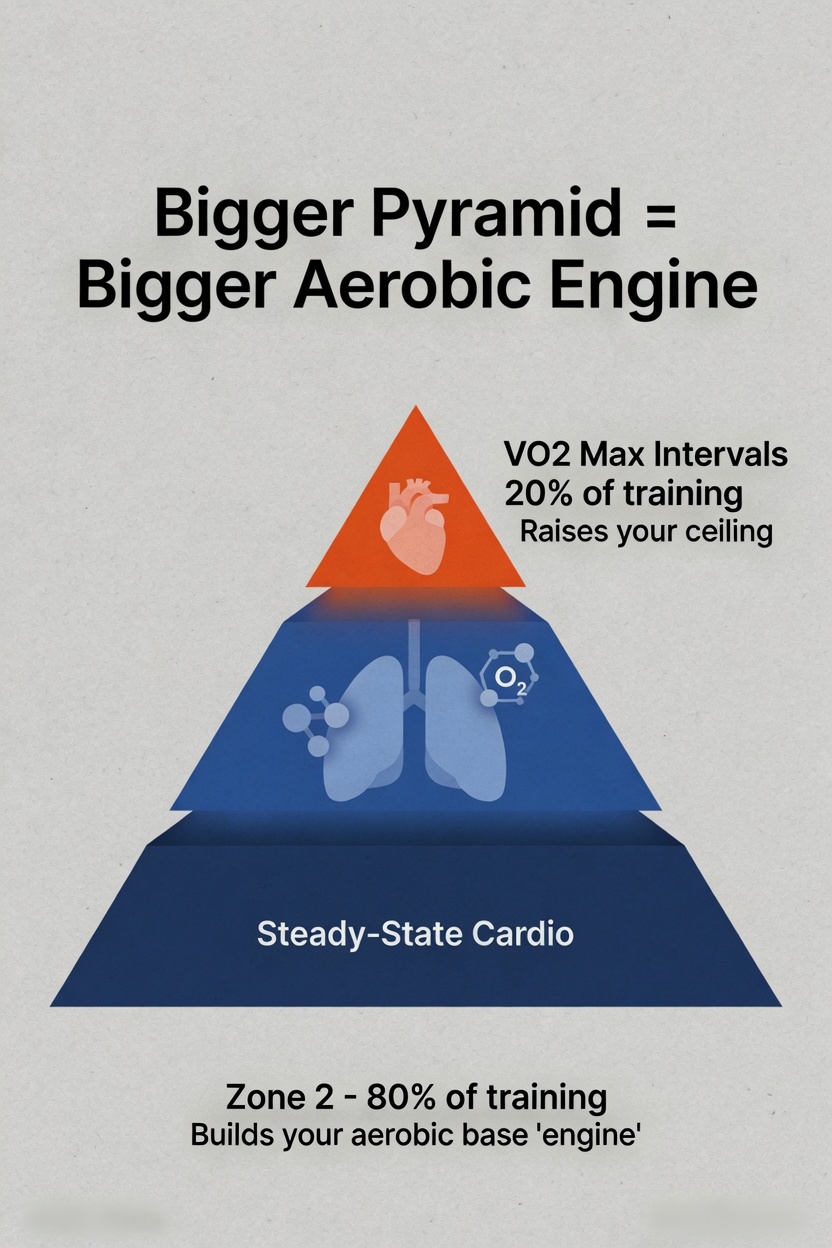
Once you know your number, the training is straightforward:
- Zone 2 base (spend roughly 80% of your weekly training time): lower-intensity, longer-duration cardio that builds your aerobic engine.
- VO2 max intervals (spend roughly 20% of your weekly training time): short, hard efforts (3–8 minutes with a 1:1 ratio of recovery) that push your peak capacity.
My weekly cardio training consists of three separate one-hour sessions, during which I spend roughly 80% of my time in Zone 2 (building my aerobic base) and the remaining time doing much higher-intensity intervals to drive up my VO2 Max.
Think of it as building a bigger pyramid—broad base, tall peak, massive overall aerobic engine.
Peter’s goal for his patients is to be two generations ahead of their peers on the fitness charts. That buffer is what lets you keep doing the things you love deep into your marginal decade.
Final Thought
You can’t change your past, but you can take 100% responsibility starting today. Whether you’re 50, 70, or 86, it’s not too late. Get tested. Define what you want your golden years to look like. Backcast. Train with purpose.
The price of discipline is small compared to the alternative. Your future self—and your independence—will thank you.

Comment below: What’s one physical activity you want to keep doing at 85? I’d love to help you backcast it and get you started on the right path.
If you’re a member at Lifetime and want to get your VO2 max tested or talk about backcasting your own Centenarian Decathlon, I’d love to help. Reach out via Work With Kelly, and let’s get you set up for your best possible “marginal years.”
Best of luck on your journey.


Leave a comment