
I watch people train. It’s what I do.
For the last few months, I’ve noticed a guy at the club I’ll call “Bob”. Solid athletic build, probably 35-40 years old, maybe 5’8” or 5’9”. He’s strong and consistent with his lifting, but he’s carrying some extra body fat—around 20-25%. Between his strength sets, he drags around this plyo box setup and goes to work.
Four bases high. He jumps up and down, facing it. Sideways. With twists. Rapid fire—15, 20, 30 reps at a skipping-rope pace. He’s clearly put in the reps because he’s good at it now.
A week or so ago, I finally asked him about it.
“I’m trying to burn extra calories,” he told me.
I smiled and gave him the truth: “Your biggest opportunity isn’t the extra jumping. It’s the food.”
He laughed and admitted it. Restaurant business. The classic struggle.
But watching him this week, something else hit me. Bob has become efficient at those box jumps. And that efficiency might actually be working against his main goal.

When Your Body Gets Too Good: The Science of Adaptation
Our bodies are master adapters. Give them the same stimulus long enough, and they optimize for it. This is rooted in the principle of specificity in exercise physiology: adaptations are tightly coupled to the exact mode, frequency, intensity, and duration of the exercise you perform repeatedly.
The more you repeat a movement, the better your movement economy becomes. Your nervous system learns to recruit muscles more efficiently, reduce wasted motion, and minimize energy leakage. As a result, you burn fewer calories performing the same task over time.
Research on running economy, for example, shows that trained athletes use less oxygen (and therefore fewer calories) at the same submaximal speeds compared to beginners. Similar efficiency gains occur with plyometrics, cycling, or any repeated-motion modality—often resulting in a 5-20% reduction in energy cost for familiar activities.
There’s also broader metabolic adaptation. Studies show that when people exercise regularly, the body can compensate by lowering resting energy expenditure, improving muscle efficiency, and even reducing the size or activity of highly metabolic organs such as the liver and kidneys. One recent study found that structured exercise led to about 40% “exercise energy compensation,” meaning the net calorie burn from workouts was significantly less than expected because the body dialed down energy use elsewhere.
Bob’s rapid box jumps are a perfect example. He’s still burning energy and getting some great conditioning benefits. But because he does the same variations every workout, his body has likely dialed in. He’s probably burning fewer calories per session now than when he first started this routine.
This isn’t laziness—it’s survival. Your body wants to conserve energy. That’s why exercise alone often produces smaller weight loss results than the raw calorie math predicts.
The Lance Armstrong Lesson: Specificity in Action
Think about Lance Armstrong. (Set the drugs aside—we’re talking pure physiology.)
Lance was a physiological beast and a freak of nature on a bicycle. He generated massive wattage, sustained high outputs for hours, and dominated the Tour de France with world-class cycling efficiency and fat-burning capacity at high intensities.
Then he ran a marathon.
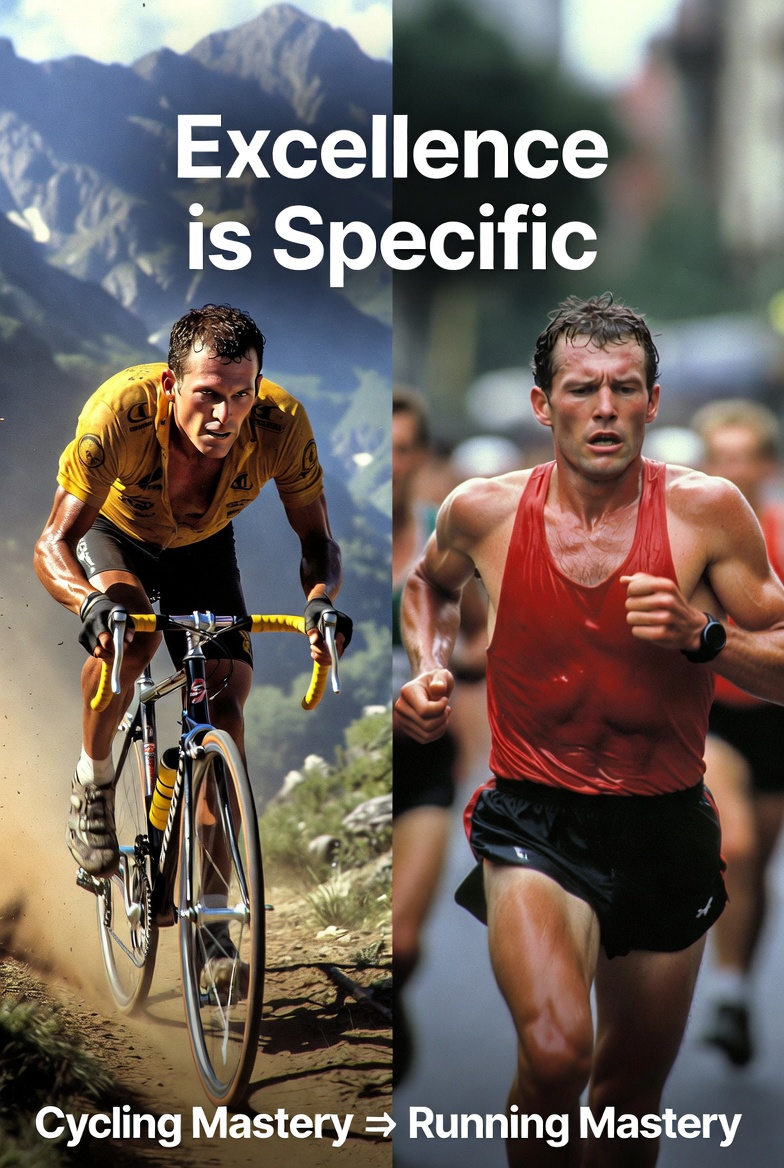
He finished respectably (around 2:46 in one attempt), but it was nowhere near the dominance he showed on the bike. The same cardiovascular engine struggled with the impact forces of running, eccentric muscle loading, and altered recruitment patterns. All that cycling excellence didn’t transfer cleanly.
Swimming showed the same gap. Great for fitness, but nowhere near his bike-level mastery.
Excellence is highly specific. When you become elite at one movement, your body optimizes for it. Introducing something new forces inefficiency again—and that inefficiency is where extra calorie burn lives, at least initially.
Better Than Doing the Same Thing Harder
Bob’s HIIT-style bursts are excellent. High-intensity interval training (HIIT) induces robust metabolic adaptations, improves mitochondrial function, boosts insulin sensitivity, and generates a pronounced “afterburn” (excess post-exercise oxygen consumption).
But staying married to the same efficient pattern limits returns for fat loss.
Instead of grinding the same jumps every session, mix it up strategically:
- Back/posterior chain day: Kettlebell swings or rowing ergometer (great posterior chain carryover).
- Leg/plyo emphasis: Keep some box jumps but add lateral bounds, sled push/pulls, or single-leg variations.
- Full body or conditioning day: Farmer carries, battle ropes, or high-rep bodyweight circuits (think hand-toe-touch, mountain climbers, or sit-outs) that leave you gasping as if a vacuum hose was shoved down your throat.




Even switching modalities within a workout can keep heart rate elevated and prevent full efficiency from kicking in. The goal isn’t to master the new movement immediately. Sucking at it temporarily is part of the benefit—it raises relative effort and energy cost.
Important Truths to Remember
- Food is still king. Extra conditioning helps create a deficit, but nutrition is still the primary lever for changing your body composition.
- Strength training comes first. It preserves muscle, which supports long-term metabolism. The bursts are the accelerator.
- Progress requires novelty. If fat loss has stalled despite consistency, adaptation to your go-to movements is often a hidden culprit. Planned variety (not random chaos) keeps the body guessing while still progressing.
You don’t need fancy equipment. You can burn a ton of calories with a combination of kettlebells, dumbbells, sled push/pulls, rowing, ski ergometers, and good old-fashioned bodyweight.
Final Thought
It’s okay to suck at exercise sometimes.
In fact, strategically embracing movements you’re not great at might be one of the smartest things you can do for fat loss. That awkward, high-effort phase disrupts efficiency and creates metabolic opportunity.
To Bob, if you’re reading this—keep lifting heavy, keep cleaning up the food, and experiment with some kettlebell swings and other metabolic conditioning modalities throughout your training week. Your body will thank you by dropping some of that extra fat.
What about you? Have you noticed your body getting too efficient at your go-to conditioning work? What new movements are you going to try mixing in this week? Drop a comment below.
Ready to Break Through Your Plateau?
If you’re tired of spinning your wheels with the same workouts and not seeing the fat loss you want, I’d love to help.
Subscribe to my blog today for more practical training insights, fat-loss strategies, and real-world coaching tips delivered straight to your inbox.
And if you’re serious about making a change, reach out to me directly via Work With Kelly for personalized coaching. Whether you’re in the restaurant business like Bob or just struggling to stay consistent, I’ll help you build a plan that actually works for your life.
Drop me a message or comment below — I read every one.
Best of luck in your journey.


Leave a Reply